· FitFab Momma · Activities · 6 min read
9 Playful Activities to Learn Letter Sounds (Not Just Names!)
When we think about teaching our kids the alphabet, our first instinct is to sing the "ABC" song and drill flashcards for "A," "B," and "C."
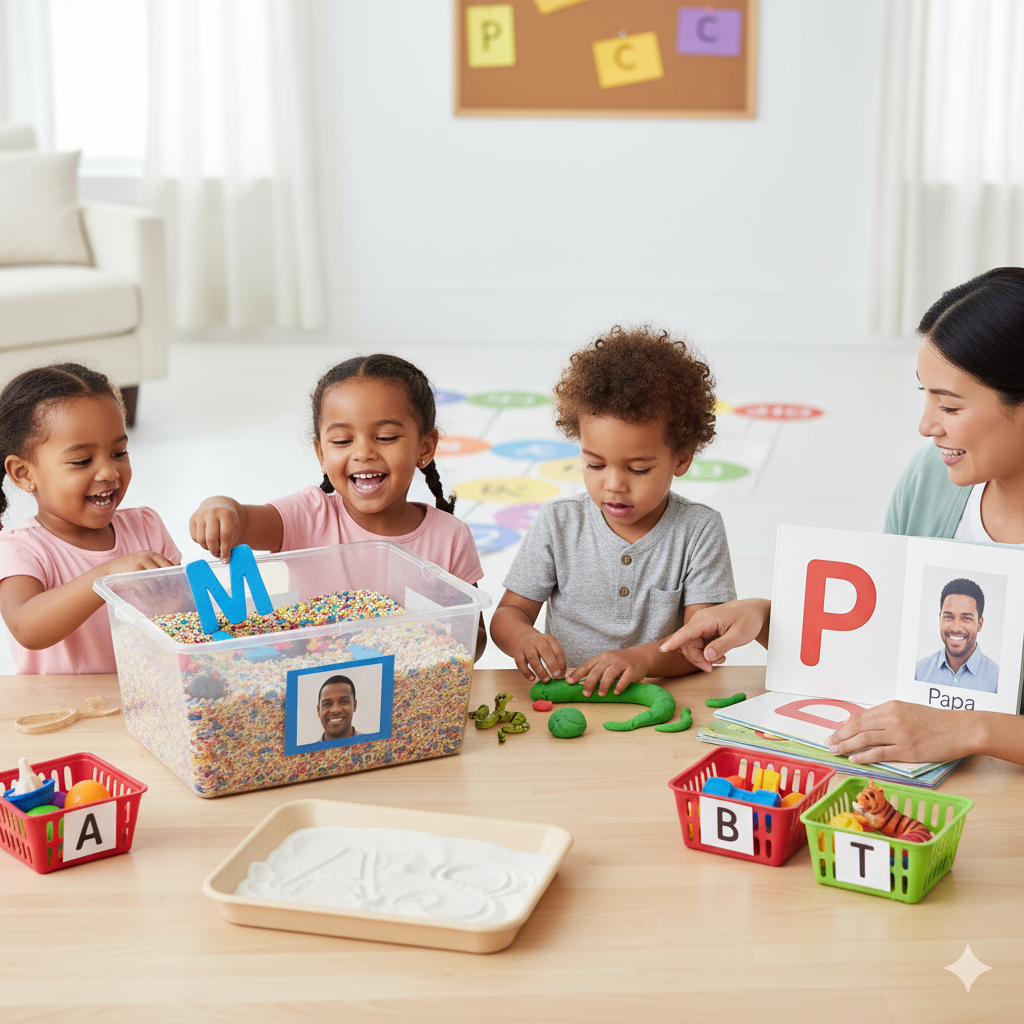
But here’s a little secret that makes a huge difference for reading: it’s more important for them to learn the letter sounds than the letter names.
Think about it. To read the word “cat,” knowing the letter names “see-ay-tee” doesn’t help. But knowing the sounds “k-ah-t” is everything! When kids know the sounds, they can start to blend them, and that’s the magic moment when they unlock reading.
The best part is, you don’t need expensive programs. You can teach letter sounds through simple, everyday play.
A Quick Pro-Tip: Start Small & Make it Personal
Before you jump in, remember: you don’t need to teach all 26 letters at once! That’s overwhelming for everyone.
Start with just a handful of letters (maybe 3-5) that are meaningful to your child. The best way to do this is to use the first letters of people you love.
- “M” isn’t just a letter; it’s Mama’s letter! It makes the “m-m-m” sound.
- “P” is Papa’s letter. It makes the “p-p-p” sound.
- “C” can be Chloe’s letter, for a sister or friend. It makes the “k-k-k” sound.
When you connect letters to loved ones, they become instantly relevant and so much easier to remember. Once they’ve mastered the sounds for those, you can slowly add more.
Here are 9 of our favorite activities to get you started.
1. Sound Spies (“I Spy”)
This is the easiest game to play anywhere—in the car, at the grocery store, or in the playroom. It trains your child’s ear to isolate the first sound in a word.
- How to Play: Instead of “I spy something… green,” you say, “I spy with my little eye… something that starts with the sound ‘p-p-p’.”
- Let them look around and guess. “Is it the… pillow?” “Yes! Pillow starts with ‘p-p-p’!“
2. The Mystery Sound Bag
Kids love a mystery. This tactile game builds anticipation and makes learning sounds a hands-on experience.
- What You’ll Need: A tote bag or pillowcase and a few small toys or objects from around the house.
- How to Play:
- Pick one of your “focus” sounds, like ‘b-b-b’.
- Fill the bag with items that start with that sound (a ball, a block, a toy banana, a book).
- Have your child reach in without looking, feel an object, and guess what it is.
- When they pull it out, celebrate! “You found the ball! Ball starts with ‘b-b-b’!“
3. Environmental Sound Hunt (The “Out & About” Game)
Use your everyday errands as a real-world letter hunt. This shows kids that letters are everywhere, not just in books.
- How to Play: When you’re at the grocery store or walking downtown, turn it into a game.
- Variation 1 (Sound First): “We’re on the lookout for Papa’s sound, ‘p-p-p’. Do you see anything that starts with ‘p-p-p’?” (They might spot peppers, pasta, or a pizza box.)
- Variation 2 (Letter First): “Let’s be letter detectives. How many times can we find Chloe’s letter, ‘C’?” (On signs, cereal boxes, etc.) When they point one out, you reinforce the sound: “Great job! That’s a ‘C,’ and it makes the ‘k-k-k’ sound!“
4. Letter Sound Scavenger Hunt
This is a perfect high-energy indoor game for a rainy day. It gets kids moving and connects that movement to learning.
- What You’ll Need: Post-it notes or small pieces of paper and a marker.
- How to Play:
- Write your “focus letters” (e.g., M, P, C) on separate pieces of paper.
- Hide them around the room—behind a pillow, on a chair, under a table.
- Tell your child, “I’ve hidden 3 letters! Go find them!”
- When they find one and bring it back, you celebrate and practice the sound. “You found ‘P’! That’s Papa’s letter! What sound does it make? ‘P-p-p’!“
5. Playdough Sound Sculpting
This is a classic for a reason. It combines fine-motor skill practice (great for pre-writing!) with auditory and visual learning.
- What You’ll Need: Playdough (store-bought or homemade) and a flat surface or mat.
- How to Play:
- Take out the playdough and choose your “sound of the day,” like “sssss.”
- Together, roll, squish, and pinch the playdough to form the letter “S.”
- While you’re building, brainstorm all the ‘sssss’ things you can think of.
- “We’re making the ‘sssss’ letter! What sounds like ‘sssss’? A snake! Or the sun. What about… socks?“
6. Sensory Sound Dig
This one is perfect for toddlers and preschoolers who love to get their hands messy. It engages their sense of touch, which helps build strong memory connections.
- What You’ll Need: A small bin or baking sheet, a filler (like dry rice, pasta, or sand), and a set of magnetic or foam letters.
- How to Play:
- Bury your “focus letters” (e.g., M, P, C) in the sensory bin.
- Have your child dig to find a letter.
- When they pull one out (e.g., “M”), you say, “You found it! That’s Mama’s letter! It makes the ‘m-m-m’ sound!“
7. Letter Sound Hopscotch
Got an active kiddo who can’t sit still? Use that energy! This game gets their whole body involved in the learning.
- What You’ll Need: Sidewalk chalk for outside, or painter’s tape / paper plates for inside.
- How to Play:
- Create a simple hopscotch grid, writing one of your focus letters in each square.
- Instead of calling out the letter name, call out the sound.
- “Okay, can you hop to the ‘m-m-m’ sound… Go!” “Now, jump to the ‘k-k-k’ sound!“
8. Sound Sorting Baskets
This is a great quiet-time activity that helps kids listen for and differentiate between sounds.
- What You’ll Need: Two small baskets or boxes. Label one with a letter (like “S”) and the other with a different letter (like “B”).
- How to Play:
- Gather a small collection of toys (e.g., snake, sock, spoon, ball, boat, bear).
- Put all the toys in a pile.
- Say the name of each toy slowly, emphasizing the first sound. “Sssss-nake. Does that go in the ‘sssss’ basket or the ‘b-b-b’ basket?”
- Let them sort the objects into the correct baskets.
9. “Magic” Finger Tracing
This pre-writing activity connects the motor skill of forming the letter with the sound it makes.
- What You’ll Need: A small tray with a thin layer of salt, sugar, or shaving cream. (You can also just use a textured piece of sandpaper or even trace on the carpet).
- How to Play:
- Show them a letter (e.g., “m”).
- Say, “This is Mama’s letter. It makes the ‘mmmm’ sound. Let’s trace it!”
- Guide their finger to trace the shape of the letter while you both make the “mmmmmmm” sound.
The Takeaway
The goal isn’t to drill them with flashcards until they’re bored. It’s to make these sounds a natural and fun part of their day. By focusing on sounds first, you’re not just teaching them the alphabet; you’re giving them the real tools they need to become confident, happy readers.